
Written by the team at Gold Standard Pest Solutions, a family run, BPCA member pest control company based in Southfleet, Kent, protecting homes and businesses across Kent, the South East and London since 2018. Call 0800 910 1179.
The short answer
Clothes moth treatment in Kent usually costs between £120 and £200 for a single affected room and between £400 and £700 for an established whole house infestation, and it takes two visits about three to four weeks apart because no single treatment kills eggs that have not hatched yet. The insect eating your jumpers is not the moth flying at the lamp. It is the larva, a small cream grub hiding in the dark under wardrobes, along carpet edges and behind skirting. If the grub is cream and smooth with silk webbing or a little tube trailing behind it, you have clothes moths. If it is brown, bristly and shaped like a tiny carrot, you have carpet beetle larvae, known as woolly bears, and the source is very often a bird nest or a dead bird or rodent in your loft.
That matters because the two pests need different treatments and different searches. Shop bought moth sprays and lavender sachets almost never fix either one, because they do not reach the larvae where they actually live.
That is the summary. Below we cover how to tell the two apart, why Kent homes get hit harder than most, what actually kills the larvae, what treatment should cost in 2026 and when it is worth calling someone in.
What is a clothes moth, and what is actually eating your clothes?
A clothes moth is a small moth whose larvae feed on keratin, the protein in wool, cashmere, silk, fur, feathers, leather and animal hair. The adult moth does not eat fabric at all. It exists to breed and lay eggs. All of the damage is done by the larvae that hatch from those eggs.
The main culprit in the UK is the common or webbing clothes moth, Tineola bisselliella. English Heritage, whose conservation team monitors textile pests across historic properties, describes them as only 5 to 8 mm long, scuttling rather than flying unless it is warm, shunning light and hiding in dark areas to lay batches of eggs on wool, fur, feathers and skins.
The larvae then spin silk webbing into a tunnel across the material and eat the fibres inside it. That is what produces the classic irregular holes in a jumper and the bald patches of missing pile on a wool rug or stair carpet.
One more thing worth knowing, because it explains why infestations creep up on people. English Heritage notes that one generation normally takes a year to develop, but up to three lifecycles can occur in warm conditions. A heated, carpeted, centrally warm home is a warm condition. That is three breeding cycles a year in your airing cupboard instead of one.

Is it a clothes moth or a carpet beetle?
This is the single most useful thing to get right before you spend any money, and it is the question we get asked most often on the phone. Here is the comparison.
| Clothes moth (Tineola bisselliella) | Varied carpet beetle (Anthrenus verbasci) | |
|---|---|---|
| What you usually see first | Small buff or golden moths scuttling near skirting, wardrobes or carpet edges | Small round mottled beetles on windowsills, or shed bristly skins |
| Adult size | 5 to 8 mm long, plain golden buff, no spots | 1.5 to 3.5 mm, rounded, mottled white, brown and yellow, like a tiny tortoise |
| The larva that does the damage | Cream or off white, smooth, up to about 12 mm | Brown, bristly, carrot shaped, about 4 to 4.5 mm, the “woolly bear” |
| Tell tale evidence | Silk webbing, silk tubes and gritty frass on the fabric | Shed brown bristly larval skins, often more numerous than live larvae, and no webbing |
| Damage pattern | Irregular holes, grazed patches, bald spots in carpet pile | Neat small round holes with no webbing, plus grazed pile |
| Where it starts | Undisturbed wool, worn clothing, carpet under furniture | Very often a bird nest, dead bird or dead rodent in a loft or cavity |
| Do they bite | No | No, though the larval hairs irritate some people’s skin |
| Speed of lifecycle | Roughly a year, up to three generations a year in warm homes | Often about a year indoors and two summer seasons outdoors, and the related two spot carpet beetle can take up to three years |
Adult varied carpet beetles feed on pollen outdoors, and indoors they are most often found on windowsills trying to get out, which is why people assume they flew in from the garden. Sometimes they did. Often they emerged from a nest above the bedroom ceiling. The Natural History Museum notes that the eggs are frequently laid in bird nests, and household infestations are commonly traced back to nests in lofts and to dead birds or rodents in cavities and under floors.
If you are finding carpet beetles year after year and treatment never seems to hold, that loft is the first place we look. Our bird control and pigeon proofing in Kent work and our rodent control work overlap with fabric pests far more than people expect.
Why do Kent homes get clothes moths so badly?
Three reasons, and they stack.
First, the geography. In 2017 English Heritage ran Operation Clothes Moth, a citizen science survey in which around 4,500 traps were handed out to the public and data came back from 42 English counties. Participants reported a total of 3,607 webbing clothes moths, an average of about 17 moths per trap, and the reported catch was much higher in the south and west of England than in other regions. Kent sits squarely in that higher catch zone.
Second, the housing stock. The same survey found clothes moth numbers were higher in older, pre 1950 properties, because they have more voids, fireplaces and attics than modern houses, and that flats and apartments were more susceptible, likely because of shared walls. Now picture Kent. Victorian terraces in Gravesend and Dartford, Georgian and weatherboard property in Faversham and Whitstable, oast houses, farm cottages, converted flats along the coast. That is close to a perfect description of the housing the survey flagged.
Third, the open chimney. A huge number of Kent period homes have an unused or decorative fireplace with a flue that was never properly capped. Birds nest in it, the nest sits there for years full of feathers and keratin, and it quietly breeds textile pests into the room below. English Heritage recommends having open chimneys checked and cleaned every year or two by a professional chimney sweep, and in our experience that single job removes the source of a surprising number of recurring infestations.
A fourth factor is not in any survey but we see it constantly. Kent has a lot of storage. Lofts, garages, under stairs, holiday lets and second homes closed up for months. Clothes moths want dark, warm, undisturbed and slightly soiled natural fibre. Storage is all four.
What actually kills clothes moths and carpet beetles?
Here is the uncomfortable truth that most shop bought products do not advertise. Killing adult moths is easy. Killing the larvae is the whole job, and the larvae are hidden.
What works:
- Freezing. English Heritage’s advice is that the best way of killing adults, eggs and larvae is to deep freeze items, sealed in plastic freezer bags at minus 18°C for at least two weeks. This is genuinely effective and it is free if you have a freezer. Use it for jumpers, hats, blankets and anything you cannot hot wash.
- Heat. Sustained high temperature kills every life stage. For anything that can take it, a 60°C wash or a long hot tumble dry is the practical way to do that at home. Professional controlled heat treatment does the same job for rugs and upholstery.
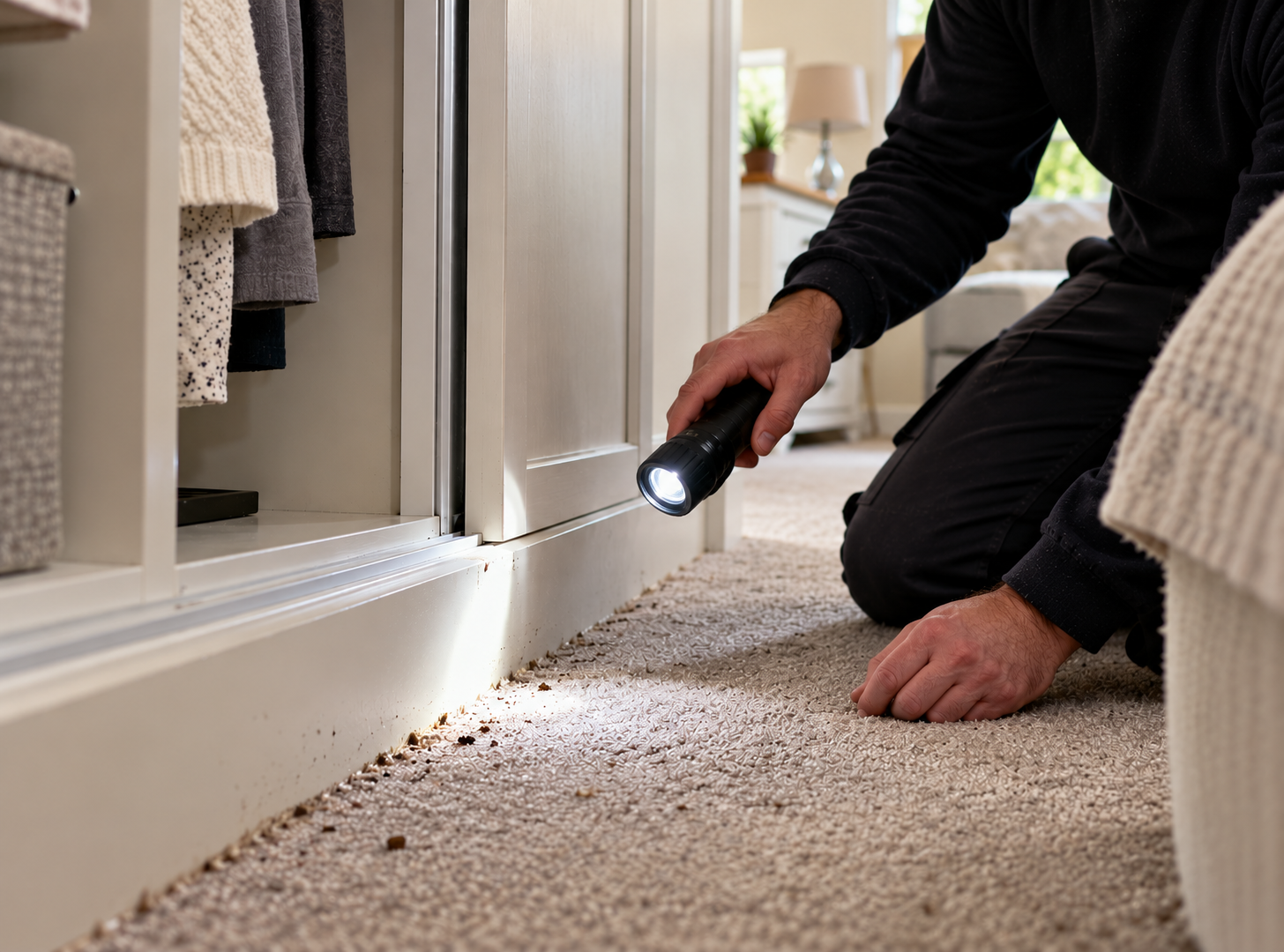
- Residual insecticide, applied properly. English Heritage notes that residual insecticide such as permethrin can be effective, although repeated treatment may be necessary. “Applied properly” means treating the harbourage, which is carpet edges, under and behind furniture, skirting gaps, wardrobe bases and floorboard joints, not spraying the open middle of a room.
- Relentless vacuuming, then disposing of the bag. Vacuum the edges and under everything, then empty the contents straight into a sealed black bag and put it in an outside bin. Otherwise you have just relocated the eggs.
- Finding and removing the source. Bird nest in the loft, dead pigeon in a flue, old wool underlay, a forgotten sheepskin, a taxidermy piece. Treatment without removing the source is money spent on a countdown timer.
What does not work, or does not work alone:
- Lavender, cedar and herbal sachets. English Heritage is direct about this. Safer alternatives to old moth balls exist, like lavender in dried, sachet or gel form, but these are not effective on larvae. They may deter an adult from laying. They will not save a jumper that already has grubs in it.
- Old style moth balls. Many of the old formulations are now banned or not recommended.
- Aerosol fly sprays. These kill adults on contact and do very little to larvae tucked inside carpet pile or wardrobe seams.
- One treatment and done. Eggs already laid are not reliably killed by a residual spray. If nobody comes back for the next generation, you get a “failed” treatment that was never actually finished. We wrote about this pattern more generally in why you still see pests after treatment.
For rugs, carpets and upholstery specifically, English Heritage recommends they are best treated in a commercial freezer or by a controlled heat process carried out by reputable companies, rather than being sprayed and hoped over.
What does clothes moth and carpet beetle treatment cost in Kent in 2026?
These are realistic guide prices for what you should expect to be quoted by a professional, insured company in Kent, based on what we and other local firms actually charge. Kent and the South East sit above the UK average for pest control, so do not be surprised if a national price comparison site quotes lower than a local firm who will actually turn up.
| Situation | Typical price range | Visits usually needed | What it should include |
|---|---|---|---|
| Clothes moths confined to one room or wardrobe | £120 to £200 | 2 | Full inspection, residual treatment of harbourage, pheromone monitoring, follow up |
| Clothes moths across two or three rooms | £250 to £450 | 2 to 3 | As above plus treatment of connecting floor voids and landing carpet |
| Established whole house infestation | £400 to £700 | 2 to 3 | Whole floor treatment, source removal advice, monitoring, written report |
| Carpet beetle treatment, one to two rooms | £120 to £220 | 2 | Inspection, residual treatment, identification of the source |
| Loft clearance where a bird nest is the source | £150 to £350 | 1 to 2 | Nest removal, loft treatment, proofing recommendation |
| Specialist rug or upholstery heat or freeze treatment | Quoted per item | 1 | Off site controlled process, usually via a specialist partner |
| Commercial contract, hotels, care homes, textile storage | From around £30 to £60 per month | Scheduled visits | Monitoring, pheromone trapping, reporting for audits |
Two warnings worth having in mind. If a quote includes only a single visit for clothes moths, that is a callout and not a treatment programme, because the second visit is what catches the generation that hatched after the first. And if a quote does not include anyone going into the loft or looking at your chimney breast, nobody has looked for the source, so you are buying a delay rather than a fix.
Clothes moths in Kent businesses: who needs to care
Fabric pests are not just a domestic nuisance. For some businesses they are a direct commercial and reputational risk.
- Hotels, B&Bs and holiday lets, especially along the Kent coast where rooms sit empty out of season with wool carpet and blackout curtains.
- Care homes, where wool blankets, upholstered furniture and stored residents’ clothing combine with rooms that are kept warm all year.
- Vintage, charity and bridal retail, where stock is natural fibre and an infestation can travel between donated items and the rest of the rail.
- Museums, heritage sites and archives, where the damage is not replaceable at any price.
- Textile storage, upholsterers and dry cleaners, where one infested item can seed a whole unit.
For these sites the answer is monitoring rather than reaction. Pheromone traps placed and recorded on a schedule tell you there is a problem while it is still cheap to solve, and give you documentation that stands up to an audit or an insurance question. Take a look at our commercial pest control page or call 0800 910 1179 for a free site survey.
When should you stop trying to fix it yourself?
Call someone in if any of these apply:
- You have treated and cleaned, and you are still finding live larvae or fresh holes four weeks later.
- The damage is in fitted carpet or upholstery rather than clothing, because you cannot freeze a staircase.
- You are finding adults in more than one room, which usually means more than one breeding site.
- You have found or suspect a bird nest, a dead bird or a dead rodent in the loft, flue or a cavity.
- The items at risk are valuable, irreplaceable or sentimental, where a failed DIY attempt costs more than the treatment would have.
- It is a business, and there is an audit, an inspection or a customer complaint involved.
If you are dealing with several pest problems at once, or you are getting the house ready for a season change, our Kent pest proofing checklist covers the physical exclusion work that stops most of them starting.
How to prevent clothes moths coming back
Prevention for fabric pests is mostly housekeeping, and it genuinely works. This list follows English Heritage’s own guidance, which is the same approach they use to protect national collections.
- Check for clothes moths in the crevices, creases and folds of clothing, and behind labels.
- Make sure clothes are clean before storing them, and store them in vacuum bags or boxes with tight sealed lids. Moths are drawn to worn fibre, not fresh.
- Take hanging items out of the wardrobe and shake them at least once a month, because moths hate being disturbed.
- Vacuum regularly around the bottom and edges of wardrobes and any shelving.
- Check underneath seats for webbing or larval cases, and look around piping, in deep buttons and in seat and arm crevices.
- Have open chimneys checked and cleaned every year or two by a professional chimney sweep.
- Check lofts and attics for bird nests, and remove and destroy any nest material found.
- Empty the vacuum into a black plastic bag, seal it and put it in an outside bin.
Add one of our own: move the furniture. The single most reliably infested square foot in a Kent living room is the wool carpet under a sofa that has not moved since 2019.
Areas we cover for moth and carpet beetle treatment
We treat clothes moths and carpet beetles across Kent, the South East and London, including Gravesend, Southfleet, Longfield, Meopham, Dartford, Sevenoaks, Maidstone, Ashford, Canterbury, Whitstable, Herne Bay, Faversham, Sittingbourne, Rochester, Chatham, Tunbridge Wells and the surrounding villages.
Call 0800 910 1179 for a free survey, or send us the details through our residential pest control or commercial pest control pages and we will come and look properly before quoting. If you can, take a photo of the insect and the damage before you vacuum, because identification is half the job and we can often tell you what you are dealing with before we arrive. You can also read more about our insect treatments.
Frequently asked questions
Do clothes moths bite? No. Clothes moths do not bite, sting or carry disease. The damage is entirely to fabric, done by the larvae feeding on keratin in wool, silk, fur, feathers and leather.
Do carpet beetles bite humans? No, carpet beetles do not bite. However, the bristly hairs shed by the larvae irritate the skin of some people and can produce an itchy rash that is often mistaken for bed bug or flea bites. If you are getting bitten at night, that is a different pest and worth reading our bed bug signs and treatment guide.
What causes carpet beetles in a house? Most commonly a bird nest in a loft or chimney, or a dead bird or rodent in a cavity or under floorboards, which provides feathers, hair and dried tissue for the larvae to feed on. Adults then move into the living space and lay eggs in carpet, under furniture and in wardrobes. Old wool underlay and stored natural fibre are the other common starting points.
How long does clothes moth treatment take to work? You should see a sharp drop in adults within a week or two. The full programme runs over about four to six weeks with a second visit, because eggs laid before treatment will still hatch. Judging success before the second visit is the most common mistake people make.
Does freezing really kill clothes moths? Yes. English Heritage’s guidance is to seal items in plastic freezer bags and freeze at minus 18°C for at least two weeks, which kills adults, eggs and larvae. It is the most reliable free method for anything you cannot wash at 60°C.
Do lavender bags and cedar balls work on moths? Not on larvae. English Heritage notes that lavender, in dried, sachet or gel form, is a safer alternative to old moth ball formulations, but is not effective on larvae. Treat them as a mild deterrent for clean, stored clothing, not as a treatment for an active infestation.
How much is clothes moth treatment in Kent? Typically £120 to £200 for one room, £250 to £450 for two or three rooms and £400 to £700 for an established whole house infestation, usually across two visits. Carpet beetle treatment for one or two rooms is usually £120 to £220. Prices in Kent and the South East sit above the UK average.
Can I stay in the house during moth treatment? Yes, in almost all cases, with a short exclusion period from treated rooms while the product dries. We will tell you exactly how long on the day and it is usually a couple of hours. We cover this in more detail in our guide on staying in your house during pest control.
Will the council treat clothes moths? Generally no. Where a Kent council still offers a pest service at all, it is usually limited to rats, mice and sometimes wasps, and fabric pests are treated as a private matter. Check your own district council’s page, because provision varies across the county. For this particular pest you want a controller who will look in the loft rather than just spray the bedroom.
Are clothes moths getting worse in the UK? The evidence suggests yes. English Heritage launched Operation Clothes Moth in 2017 after its conservators recorded that the number of clothes moths caught on traps in its properties had doubled over five years. Warmer homes, warmer winters and more natural fibre in circulation all point the same way. We are also seeing more year round activity in Kent rather than the old spring and late summer peaks.
We operate 24/7 across Kent and the South East. Call 0800 910 1179.