
Written by the team at Gold Standard Pest Solutions, a family run, BPCA member pest control company based in Southfleet, Kent, protecting homes and businesses across Kent, the South East and London since 2018. Call 0800 910 1179.
The short answer
Ashford Borough Council no longer provides a pest control service. If you live or run a business in Ashford, Tenterden, Wye, Charing, Kingsnorth or any of the surrounding villages, you need to book a private pest controller. The council’s own advice is to use a company accredited by the British Pest Control Association (BPCA) or the National Pest Technicians Association (NPTA), and to shop around on price.
In 2026, expect to pay roughly £50 to £90 for a wasp nest, £80 to £180 for mice and £120 to £250 for rats indoors in the Ashford area. Rodent jobs normally need two or three visits over four to six weeks.
Ashford also has one pest pressure most of Kent does not: it is one of the busiest areas in the country for the yellow-legged (Asian) hornet. At least six of the 66 UK nests found by the National Bee Unit by 17 September 2026 were in Ashford borough. Confirmed Asian hornet nests are destroyed free by the National Bee Unit. Everything else is a private booking.
Gold Standard Pest Solutions covers the whole of Ashford borough 24/7 for domestic and commercial work. Call 0800 910 1179 or book a free survey through our residential pest control and commercial pest control pages.
Does Ashford Borough Council do pest control?
No. The council’s pest control page is clear: it no longer provides a pest control service, and residents need to source their own. It points people to three places, and they are worth using:
- The BPCA and the NPTA, the two trade bodies for professional pest controllers
- Kent Trading Standards Checked (tschecked.kent.gov.uk), a free Kent County Council scheme that vets local traders
- For foxes, the council refers people to the Fox Project, and for honey bee swarms, to the Kent Beekeepers Association
That puts Ashford in the same position as Gravesend, Swale and Canterbury. We covered the same situation in our guides to pest control in Gravesend and pest control in Faversham. The council advises. A private contractor does the treatment.
Who pays when you rent?
If you rent in Ashford, tell your landlord or housing provider first. If rats or mice are getting in because of disrepair, such as broken air bricks, gaps around pipework or a failed drain, that is usually the landlord’s job to fix. Local councils also have powers under the Prevention of Damage by Pests Act 1949 to require owners to deal with rats and mice on their land.
What if the rats are coming from the sewer?
Across most of Ashford, the public sewers are run by Southern Water. If a pest controller finds a defective sewer or a lateral drain that serves more than one property, report it to the water company. A drain survey with a camera often finds the real source in older properties, and it is far cheaper than months of repeat baiting.
What does pest control cost in Ashford in 2026?
Kent and the South East run above the UK average because labour and travel cost more here. Industry price trackers usually put London and the South East 15 to 25 per cent above national prices, so add a margin to any generic price guide you have read.
Here is a realistic guide to what you should expect to be quoted in Ashford borough in 2026.
| Pest | Typical price range | Visits usually needed | What it should include |
|---|---|---|---|
| Wasp or European hornet nest | £50 to £90 per nest | 1 | Treatment, plus removal where safely accessible |
| Asian (yellow-legged) hornet nest | Free once confirmed | National Bee Unit | Report it, do not treat it |
| Mice | £80 to £180 | 2 to 3 over 4 to 6 weeks | Survey, traps or bait stations, follow ups, proofing advice |
| Rats (indoors or under floorboards) | £120 to £250 | 2 to 3 over 4 to 6 weeks | Survey including drains, treatment, entry point advice |
| Rats (garden, outbuilding or riverside) | £100 to £200 | 2 to 3 | Secure external baiting, burrow treatment, proofing |
| Cluster flies in a loft | £90 to £180 | 1 to 2 | Loft inspection, fogging or smoke treatment |
| Fleas | £100 to £200 | 1 to 2 | Whole property treatment, prep and aftercare |
| Bed bugs | £200 to £400+ | 2 to 3 | Room by room treatment, follow up inspections |
| Squirrels in the loft | £150 to £350 | 2 to 4 | Trapping programme, entry point proofing |
| Commercial contract | From around £30 to £60 per month | Scheduled visits | Monitoring, reporting, EHO-ready records |
Two things to watch when you compare quotes. First, a one visit price for rats or mice is a callout, not a treatment. Second, any quote that does not mention proofing is only buying you a few months. Sealing the entry points is the part that actually ends the problem.
Why Ashford gets the pests it does
Ashford is one of the fastest growing places in the South East. The Office for National Statistics recorded the borough’s population rising 12.5 per cent between 2011 and 2021, from just under 118,000 to around 132,700. Growth on that scale changes the pest picture, and so do the rivers and the farmland that surround the town.
New build homes and mice
Chilmington Green alone is planned for up to 5,750 homes, and new estates have gone up right around the town at Kingsnorth, Finberry, Repton Park and Willesborough. We get a steady run of calls from new build owners who are surprised to have mice in a house that is only a year or two old.
It is not a sign of a bad build. Three things are usually going on:
- Construction moves the mice. When farmland is cleared, field mice and house mice lose their cover and move into the nearest warm buildings, which are the finished homes next door.
- Service gaps. The gaps where pipes and cables come through walls, behind kitchen plinths and inside boxing, are often left unsealed. A mouse needs a gap of about 6mm.
- Cavities as corridors. Once inside a wall cavity or a floor void, mice can travel the length of a terrace without ever being seen.
If your new build is still under its warranty, photograph the gaps and raise them with the developer. We can give you a written proofing report to support the claim. For the question of when a single mouse becomes a job for a professional, see our guide on when to call pest control for mice.
Rats under floorboards in Ashford’s older homes
The other end of the housing stock has a different problem. The Victorian and Edwardian terraces around the town centre, Newtown and South Ashford mostly have suspended timber floors. That void under the boards is dry, dark and connected to the outside through air bricks. If an air brick is broken or a drain under the house has cracked, rats move in.
The signs are usually noise before anything else. People describe scratching or running under the floor in the evening, a musty ammonia smell, and sometimes a dog or cat fixated on one spot. Our guide to the signs of rats in your house covers droppings, grease marks and gnawing in detail, and our rat, mouse and squirrel droppings guide will help you tell which one you have.
Rats under floorboards are not a DIY job. Poison under a floor can leave a dead rat where you cannot reach it, and the smell lasts for weeks. The right approach is to find the entry point first, which often means a drain test, then treat, then seal.
The Great Stour and East Stour
Two rivers meet in Ashford, and their banks, culverts and flood meadows give brown rats a year round route into gardens and outbuildings nearby. If your garden backs onto the river or a stream, a one-off treatment rarely holds. You are dealing with a steady flow of new rats, not one colony. External bait stations, sealed compost bins and proofing sheds and decking are what make the difference.
Cluster flies in rural lofts
From late September, the villages around Ashford see the same cluster fly problem we described for Faversham. Cluster fly larvae develop inside earthworms in pasture, so homes surrounded by fields in Wye, Charing, Pluckley, Bethersden and Hamstreet are prime targets. The flies pack into lofts to spend the winter, then appear at windows on the first warm days of February. An autumn fog or smoke treatment is far easier than fighting them in spring.
Asian hornets in Ashford: the 2026 numbers
This is the part that makes Ashford different. The Animal and Plant Health Agency’s National Bee Unit publishes every nest it finds. As of 17 September 2026, it had recorded 201 credible yellow-legged hornet sightings and 66 nests across the UK this year. Kent has more than any other county, and Ashford borough has had a large share.
| Location (Ashford borough) | Nest type | Date found |
|---|---|---|
| Pluckley | Primary | 14 July 2026 |
| Wye College | Primary | 29 July 2026 |
| Great Chart | Primary | 6 August 2026 |
| Great Chart | Secondary | 6 August 2026 |
| Wye | Secondary | 15 August 2026 |
| Ashford | Secondary | 23 August 2026 |
Source: APHA National Bee Unit, yellow-legged hornet 2026 rolling update, as of 17 September 2026. Further sightings were logged earlier in the year at Leigh Green near Tenterden, Charing, Pluckley and Ashford itself, including a nest in a bird box. Another nest was found on 15 September at Harrietsham, just over the border in Maidstone borough.
Why Ashford? Geography. The borough sits between the Channel coast and the rest of Kent, with orchards, hedgerows and apiaries all around it. It is on the natural route inland from the established population in northern France.
The National Bee Unit says sightings usually peak from September onwards, as colonies reach their largest size. Secondary nests are often high in trees such as sycamores, so you may only notice hornets hunting around your garden or hovering outside beehives.
What to do if you think you have seen one
- Take a photo if you can do it safely. From 2026, the National Bee Unit can usually confirm a sighting from a clear photograph.
- Report it through the free Asian Hornet Watch app or the online form linked from the National Bee Unit website.
- Do not try to treat or knock down the nest yourself. Confirmed nests are destroyed by the National Bee Unit free of charge.
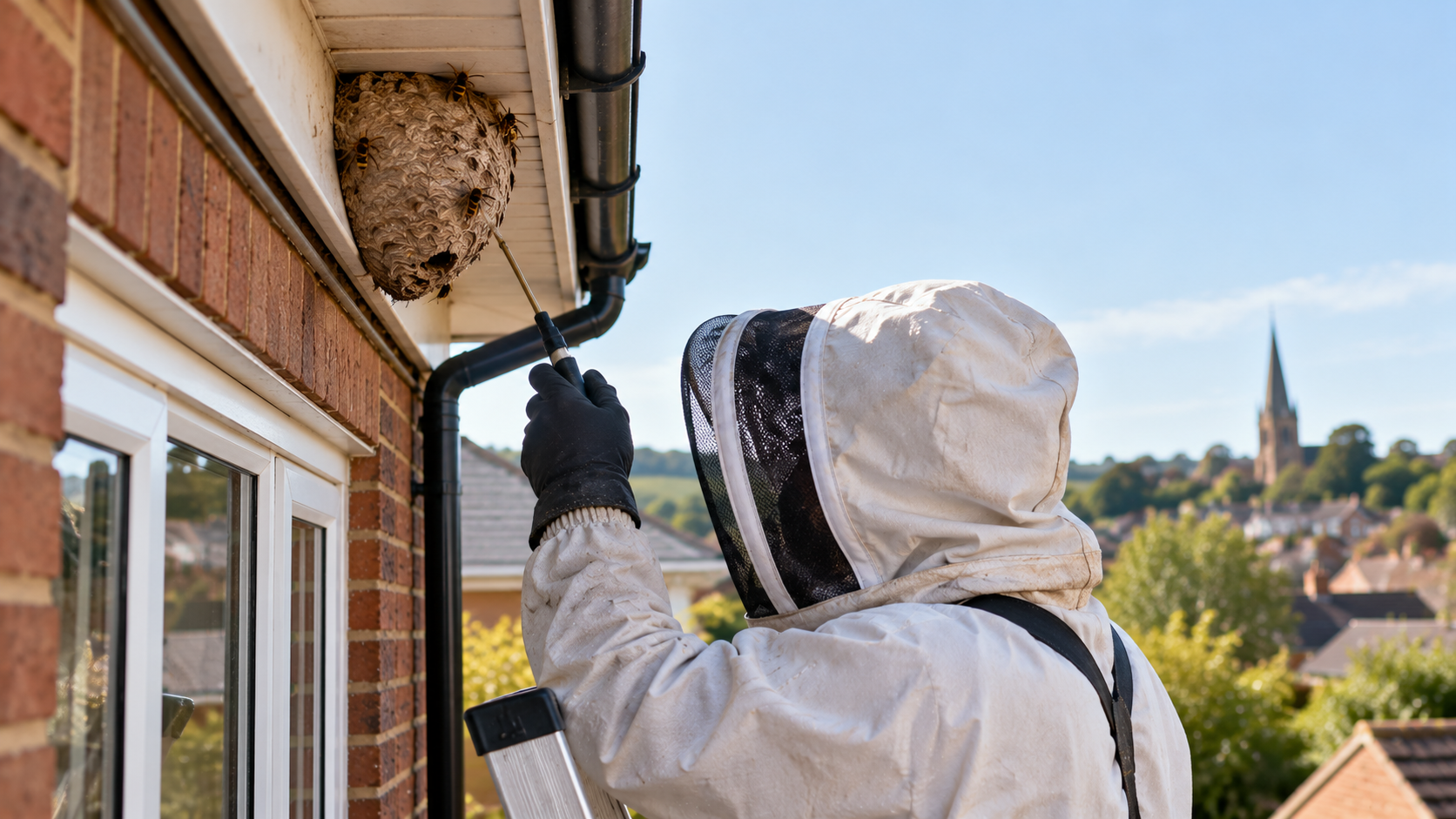
- If it turns out to be a common wasp or European hornet nest, that is a private job and we can usually deal with it the same day.
The quickest way to tell them apart is the legs. Yellow-legged hornets have legs that look dipped in yellow paint and an almost entirely dark abdomen with one orange band. We explain the full identification in our Asian hornet guide for Kent, and our wasp nest removal in Kent page covers ordinary wasp nests.
Commercial pest control in Ashford
Ashford’s economy has changed quickly. Logistics and distribution sites have grown along the M20 at Orbital Park, Waterbrook and Sevington. The town centre, the Designer Outlet and County Square bring retail and hospitality. And the villages still have farms, farm shops, pubs and food producers. Each of these carries different pest risks.
- Warehouses and logistics: large doors, pallet stock and nearby fields make rodent monitoring essential. Loading bay doors left open are the most common way in.
- Food and hospitality: an environmental health officer will want to see documented monitoring, not just a phone number for a contractor.
- Schools, care homes and offices: discreet, scheduled visits and clear records matter as much as the treatment itself.
- Farms and rural businesses: seasonal rodent pressure rises when fields are harvested in late summer and autumn.

Reactive callouts or a contract?
| Reactive callouts | Monitored contract | |
|---|---|---|
| Cost pattern | Pay per incident, unpredictable | Fixed monthly fee, typically from £30 to £60 |
| Response | After the problem is visible | Early warning from monitoring points |
| Paperwork for inspections | Minimal | Full visit reports and site plans |
| Proofing advice | Sometimes | Built into every visit |
| Best for | One-off domestic problems | Any business handling food, stock or the public |
Once a business passes two or three incidents a year, a contract nearly always works out cheaper, and it produces the records an inspector or auditor asks for. See our commercial pest control page or call 0800 910 1179 for a free site survey anywhere in Ashford borough.
When should you stop trying to fix it yourself?
DIY has its place. One mouse in a snap trap and no further activity, a single wasp on the windowsill, a handful of cluster flies you can vacuum up. Fine.
Call a professional when any of these is true:
- You have seen a rat indoors, or you hear scratching under the floor, in the walls or in the loft
- You are still catching mice after two weeks
- Droppings keep coming back after you clean them up
- A nest is in the roof, a cavity or anywhere you need a ladder to reach
- You think it could be an Asian hornet (report it, do not treat it)
- You suspect bed bugs, because DIY sprays usually make the job harder
- It is a rental, a food business or anywhere with a legal duty of care
If you have already had a treatment and the pests keep coming back, it is usually a proofing or source problem rather than a product problem. We explain why in our guide to why you still see pests after treatment.
How to choose a pest controller in Ashford
Ask four questions before you book anyone:
- Are you a BPCA or NPTA member? This is Ashford Borough Council’s own recommendation, not just ours.
- Are your technicians qualified and insured? RSPH Level 2 in Pest Management is the baseline.
- How many visits does the price include, and what happens if the problem is not solved?
- Does the quote include proofing, or just treatment?
Anyone who cannot answer those clearly is not the right firm. For a second check, look them up on Kent Trading Standards Checked.
Areas we cover in Ashford borough
Ashford town centre, Kennington, Willesborough, Singleton, Kingsnorth, Chilmington Green, Finberry, Repton Park, Great Chart, Bybrook, Park Farm, Sevington, Wye, Charing, Pluckley, Challock, Bethersden, Smarden, Biddenden, Hamstreet, Aldington, Mersham, Appledore, Woodchurch, Tenterden, Leigh Green and the surrounding villages.
We are Kent based, family run and available 24/7 for urgent jobs. Call 0800 910 1179 for a free survey, or send us the details through our residential or commercial pages and we will come out and look properly before we quote. Getting your home ready for winter? Start with our Kent pest proofing checklist.
Frequently asked questions
Does Ashford Borough Council do pest control?
No. Ashford Borough Council no longer provides a pest control service. It advises residents to find a private company accredited by the BPCA or the NPTA, to check traders through Kent Trading Standards Checked, and to shop around on price.
How much does pest control cost in Ashford?
In 2026, expect roughly £50 to £90 for a wasp nest, £80 to £180 for mice and £120 to £250 for rats indoors. Kent and the South East are 15 to 25 per cent above the UK average. Rodent treatments usually need two or three visits over four to six weeks.
Why do I have mice in my new build house in Ashford?
Nearby construction pushes mice out of cleared fields and into finished homes, and new builds often have unsealed gaps where pipes and cables pass through walls and behind kitchen units. A mouse only needs a gap of about 6mm. Sealing those gaps is what stops them for good.
How do I know if there are rats under my floorboards?
Listen for scratching or running under the floor in the evening, and look for a musty ammonia smell, droppings near air bricks and pets fixated on one spot. In older Ashford terraces, rats under the floor usually come from a broken air brick or a cracked drain, so a drain test is often the first step.
Are there Asian hornets in Ashford?
Yes. The National Bee Unit recorded yellow-legged hornet nests in Ashford borough in 2026 at Pluckley, Wye College, Wye, Great Chart (two nests) and Ashford itself. That is at least six of the 66 UK nests found by 17 September 2026.
Who removes Asian hornet nests in Ashford, and does it cost anything?
The National Bee Unit destroys confirmed yellow-legged hornet nests free of charge. Photograph the hornet if it is safe, report it on the Asian Hornet Watch app, and do not try to treat the nest yourself.
Do I need a pest control contract for my Ashford business?
If you handle food, store stock or serve the public, an environmental health officer will expect documented pest monitoring. A monitored contract, typically from £30 to £60 a month, is usually cheaper than reactive callouts beyond two or three incidents a year and gives you the records an inspector asks for.
Can you come out the same day in Ashford?
For urgent jobs, usually yes. We work 24/7 across Kent and the South East. Call 0800 910 1179.